
NeuroQuant brain volume analysis
Your brain MRI,
measured.
A standard MRI shows what your brain looks like. NeuroQuant adds numbers: the size of key brain structures, compared with people your age. Add it to any package for $399, or get it included in Full-Body Complete and Elite.
WHAT IT ADDS
From pictures to measurements.
Some changes in the brain are gradual, and hard to judge by eye on a single scan. NeuroQuant is FDA-cleared software that outlines dozens of brain structures on your MRI, measures each one, and compares it with a database of healthy people of the same age and sex, adjusted for head size.
The result is a report your radiologist can read alongside your images: where each structure sits compared with your peers, and a baseline you can measure against in the years ahead.
- FDA-clearedSoftware by Cortechs.ai, used by many imaging centers
- Compared with your peersSame age and sex, adjusted for head size
- No radiation or contrastA few extra minutes during the same MRI
WHAT THE ANALYSIS LOOKS LIKE
Outlined, measured, and compared.
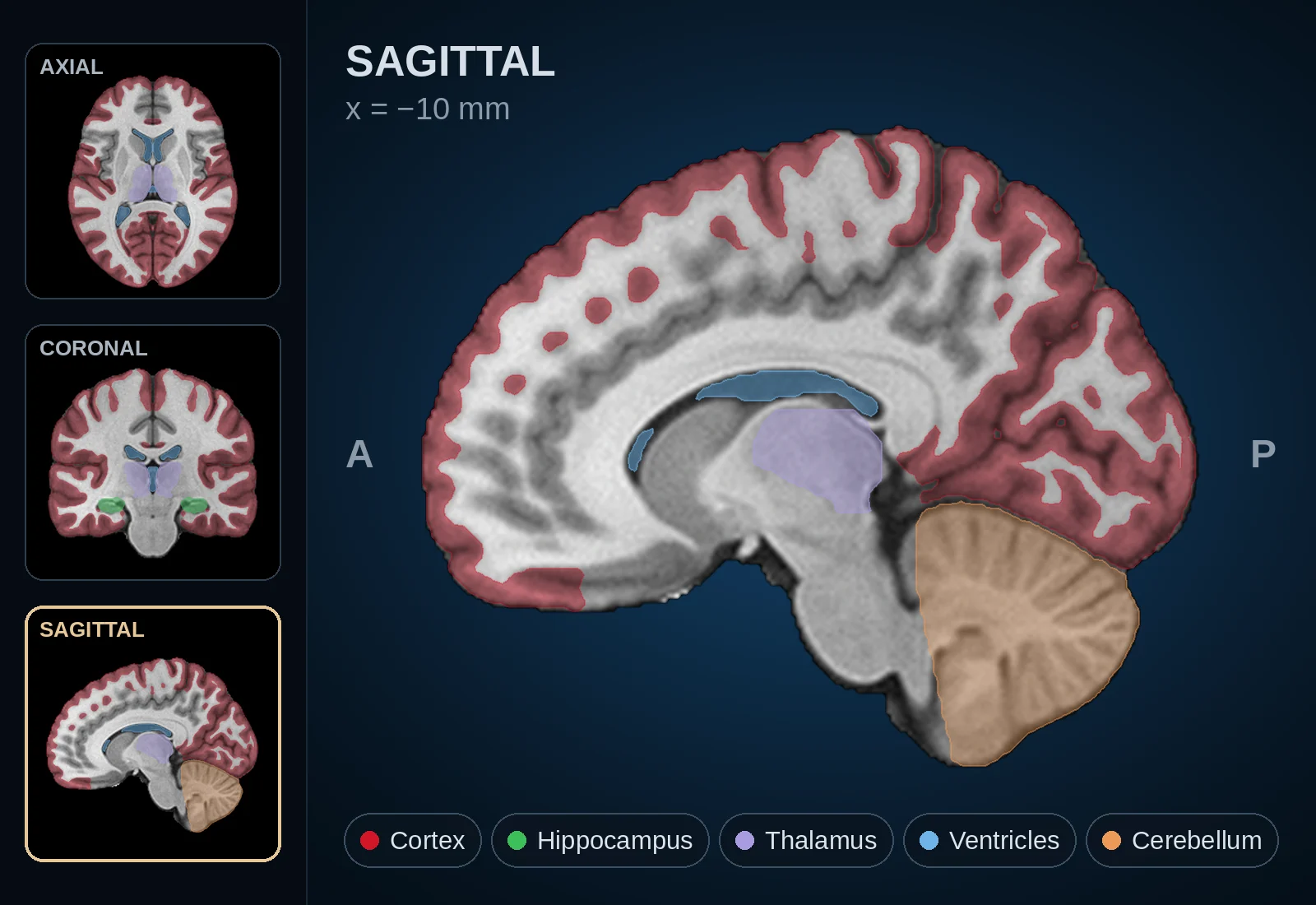
NeuroQuant works from a high-resolution 3D scan, so the same data can be viewed from the top, the front and the side. Each colored outline is a structure the software has found and measured.
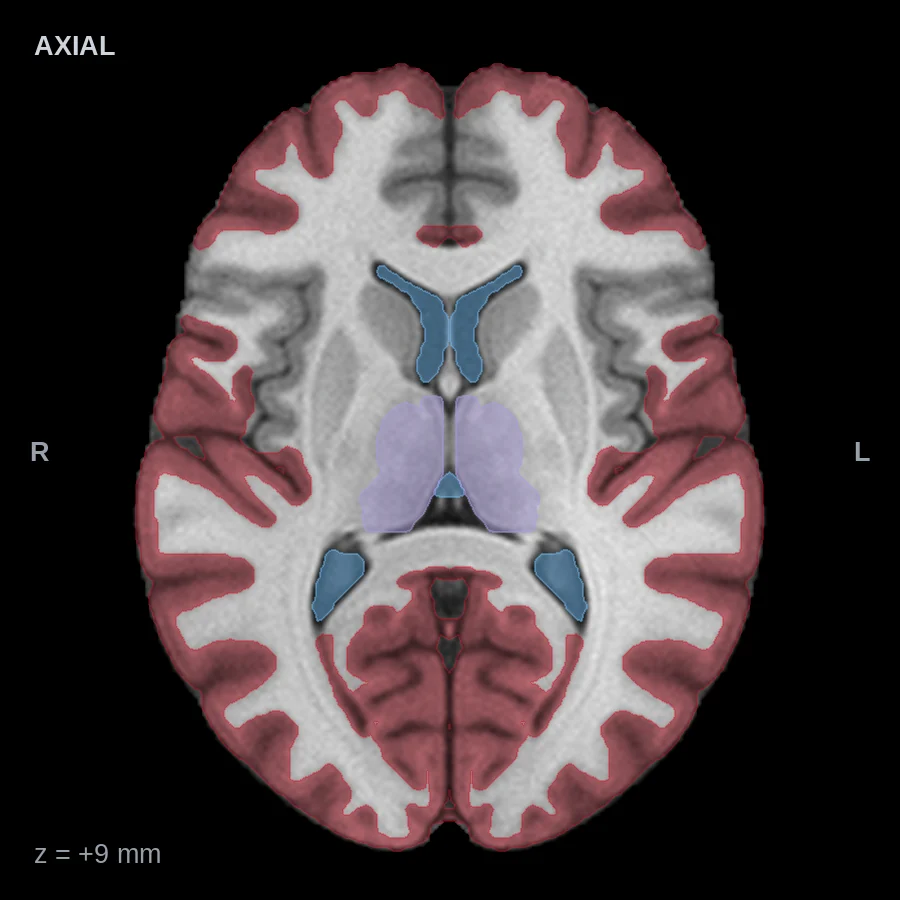
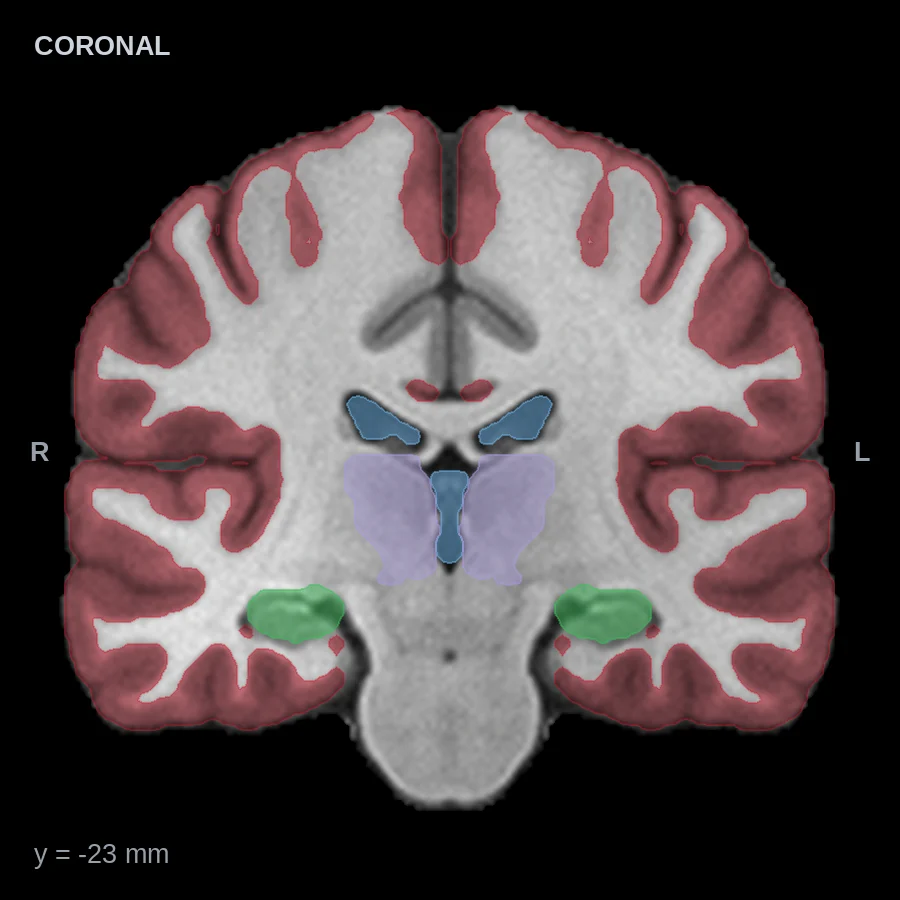
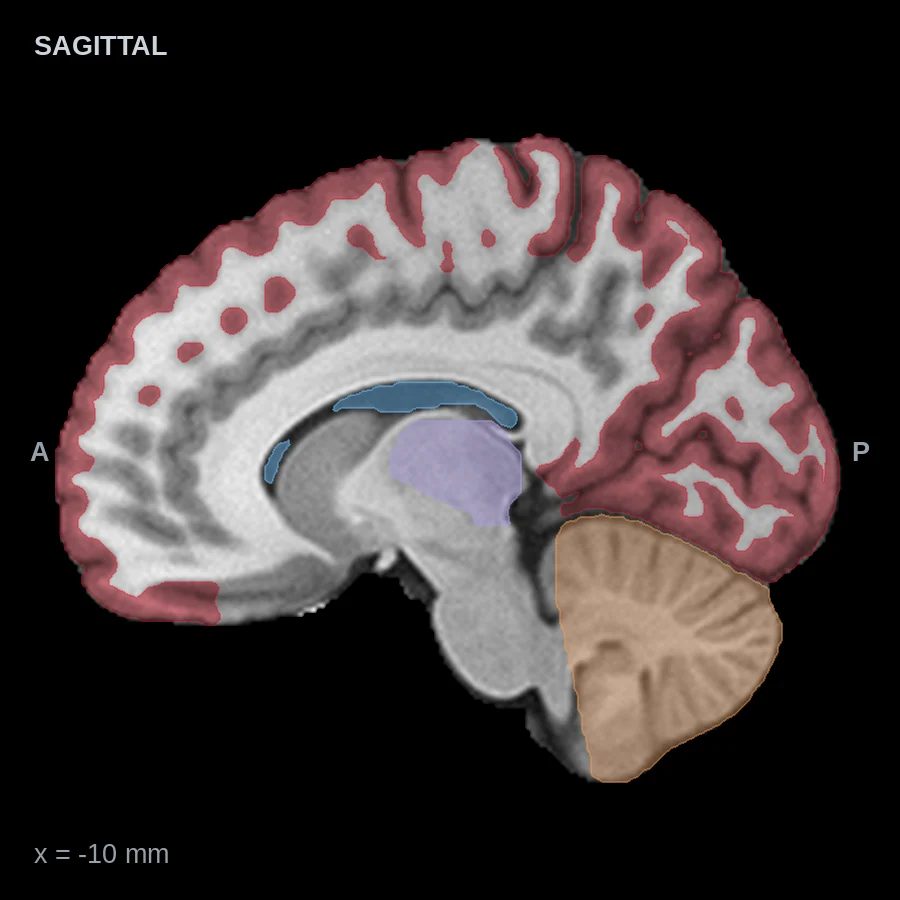
- Hippocampus
- Ventricles
- Thalamus
- Cerebellum
- Cortical gray matter
For illustrative purposes only.
HOW IT WORKS
Four steps, one visit.
A detailed 3D brain scan
During your MRI we add one high-resolution 3D sequence of the brain. It takes a few extra minutes.
Each structure is measured
NeuroQuant automatically outlines and measures structures such as the hippocampus, thalamus, ventricles and cortical gray matter.
Compared with people like you
Every volume is placed on a percentile scale against healthy people of your age and sex.
Explained by your radiologist
Your radiologist reviews the report with your images and walks you through it in your video consultation.
WHAT IT MEASURES
The parts of the brain that matter for memory.
- Hippocampus
- Central to forming new memories, and one of the first areas to shrink in Alzheimer’s disease.
- Ventricles
- Fluid-filled spaces that can enlarge as surrounding brain tissue shrinks.
- Cortical gray matter
- The brain’s outer layer, used for thinking, language and perception.
- White matter
- The wiring that connects brain regions to each other.
- Thalamus and amygdala
- Deep structures involved in relaying signals, emotion and memory.
- Cerebellum
- Coordinates balance and movement.
- HippocampusMemory58th percentile
- ThalamusRelay for sensation and movement71st percentile
- Cortical gray matterThinking and language44th percentile
- Cerebral white matterConnections between regions63rd percentile
- AmygdalaEmotion and memory52nd percentile
BEYOND THE BASELINE
What the software is used for in medicine.
NeuroQuant was built to help answer several clinical questions. Here is what it looks at, in plain terms.
Memory and aging
Measures the hippocampus and the fluid-filled spaces beside it, the two places doctors look first when memory is a concern.
Small-vessel changes
Measures how much of the white matter shows signs of small-vessel disease, a common finding with age and high blood pressure.
Head injury
Compares dozens of brain structures, grouped by region, after a concussion or other injury.
Epilepsy
Compares the left and right hippocampus, because a size difference between them can point toward temporal lobe epilepsy.
Change over time
Lines up two scans and shades what grew or shrank in color, so a slow change is easier to see than by eye.
Growing brains
Reference volumes for children age 3 and older, so each measurement is compared with the right age group.
These are uses of the software in general. A CareMVP report is a baseline for people without symptoms, and it is not a diagnosis. NeuroQuant® is a registered trademark of Cortechs.ai.
Read the manufacturer’s product informationIS IT RIGHT FOR YOU?
Who adds it, and what it can’t do.
People often add NeuroQuant when they
- Have a parent or grandparent with dementia or Alzheimer’s disease
- Have had concussions or other head injuries
- Want a baseline to compare against in future years
- Want to know more about their brain health as they age
What NeuroQuant can’t do
- It measures structure, not how well your brain works. Memory tests do that.
- A value outside the typical range is not a diagnosis. Healthy people vary.
- It can’t predict whether you will develop dementia.
- If you have memory problems or other new symptoms, see your doctor first.
PRICING
One add-on price. Or included.
NeuroQuant is $399 with Full-Body or Premium, and it is included in Full-Body Complete and Elite.
| Option | CareMVP | National providers |
|---|---|---|
| NeuroQuant brain analysis, as an add-on | $399 | About $800Where listed as an add-on |
| Full-body MRI with NeuroQuant | $2,650Full-Body Complete, which also includes the whole spine, a cardiac calcium score CT, a low-dose lung CT and a 60-minute radiologist consultation | $1,699 to $2,499, plus about $800For an MRI with the whole spine, plus a brain add-on where listed |
| Package with NeuroQuant and lab testing | Full-Body Elite, $3,499Also includes the whole spine, heart and lung CT, and an advanced blood panel | $3,999 to $4,999The most complete packages list in this range. What they include differs. |
National figures come from the public price lists of national full-body MRI providers, checked on October 6, 2026. Packages differ in the regions scanned, who reads and reviews the results, and what else is included. Prices change.
FAQ
NeuroQuant questions.
What is NeuroQuant?
Does NeuroQuant add time, radiation or contrast?
Can NeuroQuant diagnose Alzheimer’s disease or dementia?
How do I get my NeuroQuant results?
How much does NeuroQuant cost at CareMVP?
Can I repeat NeuroQuant in future years?
YOUR NEXT STEP
Measure what matters.
Start with a baseline.
Add NeuroQuant to Full-Body or Premium for $399, or choose Full-Body Complete or Elite with NeuroQuant included.